TFT devs reflect on 7 years of running the table
Overview & Key Takeaways
In an interview with Polygon, TFT devs Alex Cole and Christina Jiang talk about TFT's seven year history and its upcoming birthday event.
Nearly seven years ago, League of Legends celebrated its tenth anniversary. To mark the occasion, Riot Games announced a slew of new titles, including Wild Rift, Legends of Runeterra, and Project A (which has since turned into Valorant). A little earlier in the year, Project L, which has turned into 2XKO, was officially announced, and Teamfight Tactics (TFT) launched as a permanent game mode on the League of Legends client. Out of the five titles, TFT is the only one that has stood at the top of its genre since its release.
While TFT was able to profit from the success of League of Legends, the team behind the game did not sit idly. Instead, it has continued to innovate and propel TFT to the forefront of the multiplayer auto battler sphere. On June 26, Teamfight Tactics will turn seven years old. Ahead of its anniversary, Polygon spoke to Alex Cole, head of gameplay for TFT, and Christina Jiang, senior product manager for TFT, in a video call about the lessons learned since launch, along with Pengu's Party, its upcoming celebratory game mode.
TFT has gone through seventeen official iterations since launch. These can largely be grouped into three (unofficial) eras: Early sets (Sets 1 and 2), Mid-sets (Sets 3 - 9.5), and Modern sets (Sets 10 - Present). Sets are TFT's version of "seasons" that are often found in other live-service games.
 Image: Riot Games
Back in 2019, the auto battler genre was the wild west, and it was apparent in TFT. "I think we often look towards those sets of like, 'Whoa, we should never do that again,'" said Cole. "A lot of the designs, like the items or even some of the traits are just so incredibly sharp and just tough to play around. It was very rock, paper, scissor-y in a lot of ways. … I think there's just a lot of nostalgia for things that, if they shipped today, I probably would actually despise in a game, like Phantom, where it's just like, 'Oh, I don't have a carry anymore. Oh well.'"
In the first TFT set, Phantom was a trait that reduced an enemy's health at the start of a battle. It was like you started a boss fight at 10% HP. It was iconic, but it was also extremely divisive — and probably not something you would want to see return in a future iteration.
That hasn’t stopped fans from asking the team to bring back early sets — and the developers have discussed it, too. “If we put Set 1 in the game today, would we all be like, 'This is so fun. I'm having the time of my life," or would we want to make some changes?" said Jiang. "When we revive a set, we want to keep the core essence of the set, so the sharpness of old TFT is what was crazy and nostalgic and fun, but how do we bring those back? … The early sets, definitely, there's so many learnings from them, but I agree the sharpness is probably one of the things we're like, 'Wow, this was crazy back in the day.'"
As TFT moved into Set 3: Galaxies, it entered a period of "mid-sets." A set would last for three months, then it would be revamped with a "mid-set," which added a new mechanic and replaced a few traits and their respective units. The mid-set would last for another three months, which allowed for two full sets a year. This era of TFT features some fan favorites like Set 3.5 and 6, but some fans felt that mid-sets weren't exciting enough to justify the extended duration. The reception was a reckoning for the development team.
 Image: Riot Games
Cole explains that once a new set was ready for players, almost the entire design team would begin work on the mid-set — before they could tell what was working and what wasn’t. “I think it was hard for us to fully digest a week of PBE [Public Beta Environment] data, which isn't even a full TFT experience, to create a new experience. We were also just really capped in what we could accomplish with a mid-set. We knew we wanted to take out some traits to make it feel fresh or bring in new champions, but just timeline-wise, we were limited to doing 20 at the absolute most, and that was a huge mid-set undertaking. We also had to come up with some type of mechanic in that time. Normally, it was a smaller swing, but we wanted to do something to add more novelty to the set. It was just really, really tough on the dev team."
Cole added, "At the end of the day, it wasn't really worth it for what we were able to deliver players. When we had the opportunity to just say, 'Hey, we can either keep working on mid-sets and deliver sometimes really cool experiences and sometimes meh experiences, or we can just deliver a full 'nother set for the year,' we decided to just ship another set because that just seemed way more fun for players."
As a result, the development team pivoted to three full sets a year after Set 9.5. In turn, the team took what they learned from mid-sets and adjusted their design process accordingly.
 Image: Riot Games
"We start a set working on it about a year out, so we're just kicking off Set 20 right now, like early thematic work and kind of scaffolding the trait web, and that was just time we never had in the two sets and two mid-sets a year," said Cole. "It allows us to take bigger swings thematically, and with art, we're able to create experiences like we did with Into the Arcane, where we made 10 to 12 characters. We could never do that on our old timelines … so it just allows for much richer experiences for every set."
While the team has more ample time to design new sets, there is less time to implement learnings from one set into the next. TFT is now on Set 17: Space Gods, but it came after a beloved set in 16: Lore and Legends. It introduced Unlockables, a mechanic where 40 champions were added to the usual roster of 60, but to play them, you had to satisfy their Unlock conditions.
"We wanted to make sure that if we brought [Unlockables] back, we did it in a way that we were excited about, instead of just very quickly putting them into the next set," said Cole. "Even though we knew players loved them, we had to make the call of like, 'Hey, this set's just too deep in development for us to throw 40 new champions into the mix.' So while we are excited to get that back … we have to wait just because of dev cycles."
Cole added that bigger systems like Unlockables will usually take at least one set to make it into the next set, but when asked if Unlockables would return in Set 18, he said, "They should look forward to them in the future. Soon."
 Image: Riot Games
As TFT grows in both age and development, it faces a dilemma common to live-service games: How do you add new and exciting systems for veteran players, while keeping the game approachable for new players?
"It's a really tough balance at this point. On the whole, we kind of view TFT has reached its complexity cap," said Cole. "We are really careful moving forward, whereas we weren't previously … Old mechanics just became core parts of the game. We can't do that anymore, even if we are really excited about a mechanic, because we do want to make sure that TFT is a really approachable game for our new folks."
The TFT development team continues to invest in systems that make the experience smoother for new players. They've introduced systems like the Team Planner, which allows players to save team compositions and track their respective champions. Cole added, "We'll also have more investments for new players this coming year that should help a lot, in terms of just being able to more easily ramp into the game more holistically, just outside the set."
One way the team continues to pioneer their way through the genre is by proving they're not afraid to take risks. A recent example of this approach came with the decision to remove the Carousel, a core mechanic that has been around since the game’s inception, in its most recent set. While competition may start to sprout, for the time being and for the past seven years, TFT has held its spot at the top.
 Image: Riot Games
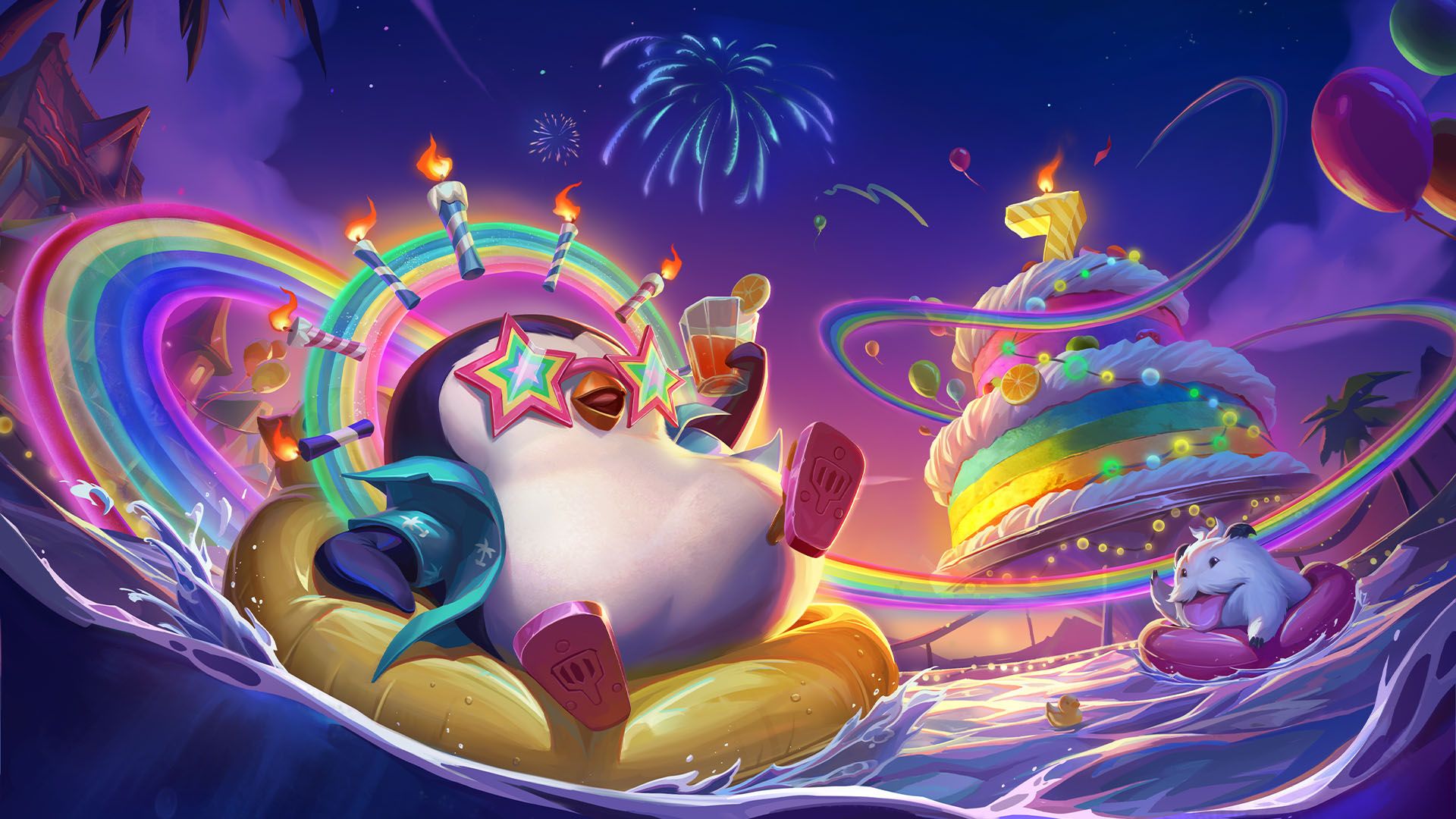
To celebrate its seventh anniversary, the TFT dev team is bringing back Pengu's Party from June 10 to July 14. In Pengu's Party, you'll play a game of Set 17, only slightly modified, as you can improve your team composition with iconic traits from previous sets. Over the course of the game, you'll choose two traits, with the first two traits starting out at the "bronze" tier. For your third choice, you get to upgrade one of your traits to the "prismatic" tier. Everyone's dream in TFT is to get the strongest unit possible, which is the three-star five cost. That's still possible in Pengu's Party, but given how chaotic this game mode can be, it still may not be enough to win.
"The goal of Pengu's Party is to allow players to experiment and cook with traits from past sets, and build high power and high cap boards that you really can't see much on live," said Jiang. "Compared to some of our other game modes, like Choncc's Treasure, where the most capped board of Choncc's Treasure, and honestly in TFT live, is like a three-star five cost. In Pengu's Party, the boards that win are not three-star five costs. That's explicitly not the design goal because that space is already served. It's more about experimenting and cooking … I would say it's probably true flex TFT."
For players who love flex play or those who just need a break from the ranked grind, Pengu's Party may be the perfect bit of chaotic fun. To make it even more enticing, you'll also receive rewards for playing like star shards, treasure tokens, realm crystals, and even the Anniversary Scuttle Crab little legend.
 Image: Riot Games
As TFT turns seven, competition in the multiplayer auto battler space is just starting to ramp up. Companies like TiMi Studio Group, developer of Honor of Kings, and Hoyoverse, developer of Genshin Impact and Honkai: Star Rail, are about to enter the fray. However, Riot and the TFT team are confident that they will stay in the forefront.
"We've actually been really excited about seeing a lot of new games come out," said Cole. "Personally, I just love the genre, so I'm always just craving more experiences in it … I think the experiences that a lot of other games have offered so far are a little bit shallower strategy-wise, and it's a little bit like a lighter bite version of it, which I think is cool. … If they're looking for a little bit more depth, I think that's where TFT can come in and offer that much deeper strategic game."
Jiang added, "one of the things we invest in so much is really our content … I think it's really hard to start off as an auto battler genre and then release three sets a year and a bunch of new game modes per year. The team works really, really hard to get that out to players and is constantly evolving, pushing ourselves to innovate and create new experiences for players."