30 Years Ago, a Japanese Sci-Fi Fantasy Spinoff Quietly Transformed RPGs Forever
🎮 PlayStation, Multi-platformNews
🎮 Persona#Opinion#Persona

30 Years Ago, a Japanese Sci-Fi Fantasy Spinoff Quietly Transformed RPGs Forever

Polygon RSS FeedJason Venter4 min read(about 5 hours ago)

Overview & Key Takeaways

Modern Atlus RPG releases might not be recognized worldwide without one amazing game that launched 30 years ago.

Today, many RPG fans are well acquainted with Persona 3, which originally debuted in Japan on July 13, 2006. That game carried the series to new levels of success, ensuring a reliable audience for each new entry. Just look at how many people are eagerly awaiting Persona 6, a full 20 years later.

Despite the Persona franchise’s enduring popularity, few gamers have played the earliest entries that paved the way for Persona 3, especially Revelations: Persona. It was the first game in the now enormously popular spinoff franchise, and launched for the original PlayStation in Japan as Megami Ibunroku Persona on Sept. 20, 1996.

By the time Persona arrived, Atlus had already published numerous entries in its long-running RPG series, Megami Tensei. That series wouldn’t make its first appearance in North America until Shin Megami Tensei: Nocturne in 2004 (known in Europe as Shin Megami Tensei: Lucifer’s Call), but it did well from the Famicom days in Japan. After the second Shin Megami Tensei installment for Super Famicom, the team decided to shift its focus and eventually produced Shin Megami Tensei If…

That new game, released for the Super Famicom on Oct. 28, 1994, introduced a more intimate setting than its predecessors: the halls of the fictional Karukozaka High School, which had recently come to occupy the demon realm. Players could form alliances with various students and eventually confront Ideo Hazama, a brilliant student who was bullied until he snapped and summoned a demon to get revenge. His fateful decision led to the high school’s awful predicament at that game’s onset.

Given Nintendo of America’s policies on localization and censorship, it’s easy to see why Atlus didn’t bring that game to overseas audiences. American parents would have likely responded with pitchforks and protests, but audiences in Japan were considerably more receptive. Their response made the game a large enough success that Atlus decided to expand on the overall concept with Persona.
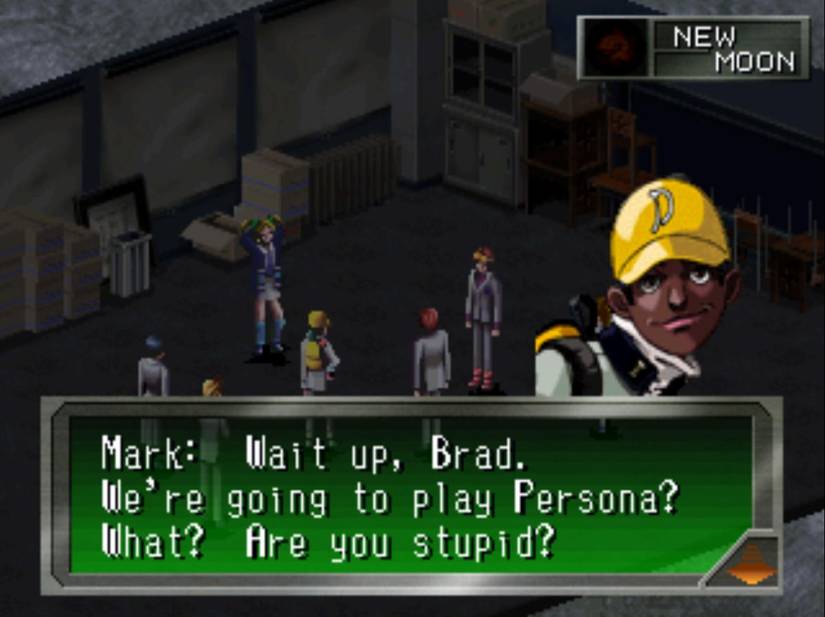
Persona screenshot - Mark asks Brad if he is stupid for wanting to play Persona Image: Atlus

In Persona, a group of high school students are playing a fortune-telling game when they unexpectedly gain the ability to summon powerful supernatural entities known as Personas. One hospital visit and a demon attack later, they find themselves roaming the town of Mikage-cho and battling monsters using their newfound capabilities. The game’s story eventually splits into two “routes,” depending on choices the player makes. One way or another, the ultimate goal is to save the town from evil.

Compared to the notoriously difficult Megami Tensei games up to that point, Persona emphasized approachable combat and progression. That made it the perfect game to bring to North America. The shift to students battling personal demons in a more intimate setting, instead of the possible destruction of the entire planet, set it apart from other RPGs of the era. Persona’s writers paid more attention to the inner emotions of its cast of characters, while retaining broad connections to the older games. At the same time, both Megami Tensei and Persona feature many familiar monsters inspired by mythology and pop culture, and their combat centers around elemental interplay and honing in on an enemy’s weakness. Persona 3 may have been the first game in the series to include the influential social links system, but Atlus made many other decisions early on that have served the franchise well.
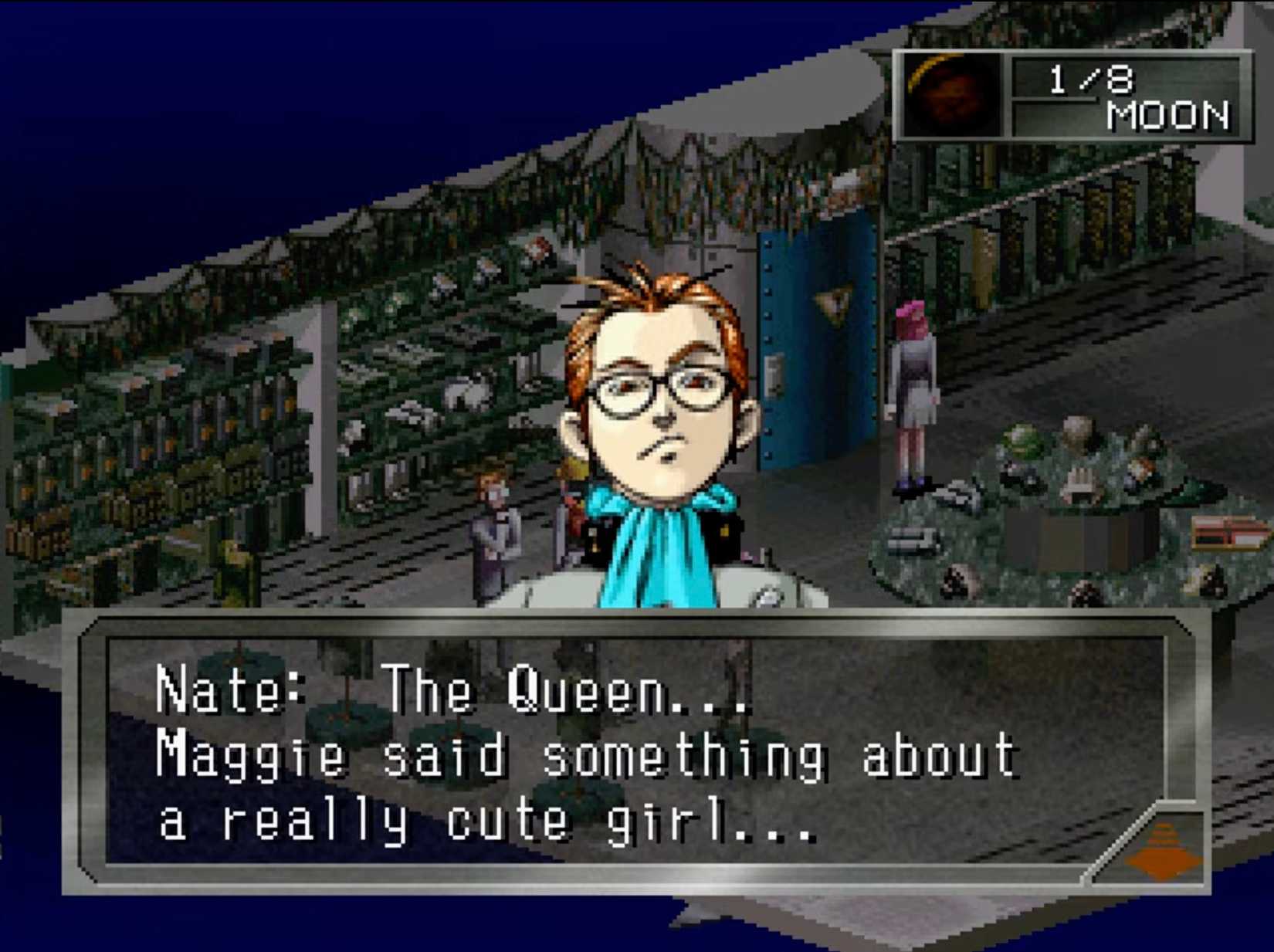
Persona 1 PS1 screenshot Image: Atlus

Localization by Atlus USA stripped out a lot of the stuff that might have offended or confused western players, who had grown up on a steady diet of Final Fantasy and Dragon Warrior games. The alternate “Snow Queen” route through the game was also eliminated, though mostly as a result of time constraints rather than censorship of content. Given the relatively small time between the game’s original launch in Japan and its release overseas, the localization team wouldn’t have had a lot of time to get everything sorted.

Happily, the success of Persona 3 a few years later gave Atlus the confidence to go back to its roots and fix issues in the first game that its original localization introduced. Shin Megami Tensei: Persona for the PSP released in North America on Sept. 22, 2009 and finally offered both routes through the game, along with a variety of other improvements. It had arrived in Japan earlier that year as Persona, no longer needing to reference the Megami Tensei series in order to fly off shelves.

Today, the original Persona is remembered more for the franchise it introduced than for its individual merits. If you want to play it, the PSP version is the one to go for, especially if you mean to play in English. Whatever version you try, it will feel a bit rough by 2026 standards, but without those early faltering steps, we wouldn’t have the franchise we enjoy today. Maybe Atlus will do us a favor and give it another update, after finishing its work on Persona 4 Revival.

Get Polygon’s Wishlister newsletter

A weekly cheat sheet to what you’ll eventually love to play. No buying, no commitment — just saving for later.

Sign up free

Free. Unsubscribe anytime.

Share:

More in PlayStation, Multi-platform

Bloodborne Is Officially Back with a New Release — but There's a Catch🎮 PlayStation, Multi-platform

Bloodborne Is Officially Back with a New Release — but There's a Catch

Bloodborne fans still hold out hope for a sequel. Instead, they're getting new Bloodborne merch, like an umbrella and necktie.

🎮 Bloodborne
PolygonNewsabout 9 hours ago
Epic X-Men Villain Is Absolutely Terrorizing Marvel’s Wolverine Players🎮 PlayStation, Multi-platform

Epic X-Men Villain Is Absolutely Terrorizing Marvel’s Wolverine Players

Omega Red, the first boss fight in Marvel's Wolverine, is a shockingly difficult skill check, stumping new players of Insomniac's PS5 game.

🎮 Epic X-Men Villain
PolygonNewsabout 10 hours ago
Resident Evil Finally Captures The Breathless Terror Of The Games🎮 PlayStation, Multi-platform

Resident Evil Finally Captures The Breathless Terror Of The Games

Few movies can truly say they hit the ground running, but Zach Cregger’s Resident Evil is among them. And that’s a good thing, because after so many Resident Evil movies, every new one needs a running start to have a chance of making it. We can’t talk about a Resident Evil movie without doing a little bit of table-setting first, though. Resident Evil debuted on PlayStation in 1996 and coined the name for an emerging game genre: Survival Horror. Since then, Paul W.S. Anderson has directed six live-action Resident Evil movies starring his photogenic and acrobatic wife Milla Jovovich. 2021 brought us the Robbie Amell-led Resident Evil: Welcome to Raccoon City. That’s not counting the half-dozen CGI Resident Evil movies that more or less act as canonical extensions of the game series. Generally speaking, the Resident Evil movies have been on a downward trend since early into Anderson’s tenure. Now, in 2026, the unkillable movie franchise rises again, this time with Zach Cregger, director of Barbarian and Weapons, acting as the head of the monster. https://www.youtube.com/watch?v=mNd1gb19A-c Resident Evil follows medical courier Bryan (Austin Abrams) as he drops off a package and argues with his girlfriend over the phone. Instead of going home to talk to her about it, though, Bryan jumps at the chance to take a high-priority delivery to Raccoon City. It needs to get there intact, and without any detours. A perfect way to not talk about any personal problems Bryan might have. Bryan starts questioning his decision when he hits a woman in a nightgown while driving in the dark down a slick road in heavy snow. That moment marks the point in which Bryan is in over his head and finds himself in a race to survive. Bryan is not a hero. He is perhaps the least heroic character to lead a Resident Evil movie. And that’s a huge factor in why this disgusting, hilarious, and often frightening movie works. Bryan doesn’t have special forces training, and like so many of us, he’s only ever wielded a gun using a video game controller. As he curses and fumbles his way through this horrifying night, he’s easy to sympathize with. He’s a sort of self-insert character for the audience, but not in the usual way we think of. What if you sat down to play Resident Evil for the first time but woke up in that world? The vast majority of us would be stuck in a stumbling run, trying to load the last rounds we have with shaking hands. That’s Bryan–always breathless and on the edge of a panic attack. But Bryan never stops, and the movie doesn’t, either. Resident Evil runs at a breakneck pace through the film's entire 95-minute runtime. There are no quiet moments to breathe and reflect: It’s a horrible night where one disaster pushes Bryan into the next one. Each time he’s found something resembling safety, he’s yanked right back into the endless nightmare. It’s a marathon movie in the vein of movies like Mad Max: Fury Road and Run Lola Run. !(https://www.gamespot.com/wp-content/uploads/2026/09/resident-evil-01.jpeg) !(https://www.gamespot.com/wp-content/uploads/2026/09/resident-evil-02.jpeg) !(https://www.gamespot.com/wp-content/uploads/2026/09/resident-evil-03.jpeg?w=636) !(https://www.gamespot.com/wp-content/uploads/2026/09/resident-evil-04.jpeg) !(https://www.gamespot.com/wp-content/uploads/2026/09/resident-evil-05.jpeg?w=636) !(https://www.gamespot.com/wp-content/uploads/2026/09/resident-evil-06.jpeg) As such, Resident Evil is more of a tense movie than a scary one. There are a handful of great jump scares, of course, and tons of viscera just everywhere. It’s also a very funny movie. Cregger cut his teeth on the sketch comedy show Whitest Kids U Know (he’s in good company with Jordan Peele and Curry Barker as sketch comedy alums making some of the best horror flicks around), and he’s said in interviews that he had to cut tons of jokes. Our protagonist copes with his nightmarish surroundings with humor. The jokes land, but they don’t destroy the tension and terror by any means. In fact, some of the best laughs come when we know something very bad is about to happen, and I still found myself backing into my seat when the bad thing came to pass. Resident Evil fans will find plenty to enjoy here. There are no cameos from any Raccoon Police Department officers or members of STARS, but there are references all over the place. These are things that the average moviegoer might notice, but that only fans will understand. And even the monsters feel like they were created by and for Resident Evil fans. There aren’t actually that many zombies in this movie, though they certainly do help propel it along. Instead of relying on classic Resident Evil monsters, Cregger treats us to mostly original monsters, but ones that feel like they’re in the lineage of the T-Virus. Masses of arms and legs, tentacles that end in teeth, you name it. I felt right at home watching the movie, but it still surprised me with awesome, gnarly, and nauseating monsters around every corner. By backing away from the stories and characters of the video games, Cregger dodges the giant bullet of “that’s not my Leon Kennedy” and instead lets us finally experience Resident Evil ourselves, through our own eyes. The artifice of a campy action movie is gone, and we’re left with a terrified guy who runs from one set of problems, only to encounter something far worse.

🎮 Resident Evil
GameSpotReviewsabout 12 hours ago