Blizzard Explains How Diablo 5 Avoids Diablo 4's Open-World Problem
Overview & Key Takeaways
Overlay maps will also be in Diablo 5 from day one
If you watched the Diablo 5 panel at BlizzCon 2026, you likely heard that Blizzard is once again embracing procedural generation for the overworld in its forthcoming action RPG. This is a stark contrast to Diablo 4, which controversially had a mostly static open world for players to explore.
During a group Q&A that Polygon attended at BlizzCon, Diablo 5's game director and executive producer delved into how the team is embracing overworld procedural generation once again and learning from Diablo 4's biggest mistake. Hardcore Diablo fans will be happy to know the game will feature an overlay from day one, too.
Even Blizzard knows Diablo 4's open world isn't great
Diablo 2 and 3 procedurally generated its outdoor open worlds, which connected dungeons, but Blizzard made the controversial decision to give Diablo 4 a static open world. While this was better tailored for *Diablo 4'*s online-focused approach, the community didn't love it. Now, even franchise executive producer Matt Zitterman admits that it was a real pitfall of Diablo 4, as it only allowed players to have a sense of discovery for a single time when they discovered a new area.
Get Polygon’s Wishlister newsletter
A weekly cheat sheet to what you’ll eventually love to play. No buying, no commitment — just saving for later.
Free. Unsubscribe anytime.
"Players had so much fun in Diablo 4 unfurling the fog of war...That was an experience that was kind of one and done, right? But players want that. They want that sense of constant discovery," Zitterman explained. "One of the reasons that we returned to the procedural world for Diablo 5 is because we saw that it was this great, amazing experience to explore what the full world of the eastern continent looked like in Diablo 4, but that was an experience that you really only were able to have once, and we wanted to be able to provide that as a more constant experience."
Like contemporary open-world games, Diablo 4 also didn't launch with an overlay map feature, instead simply relying on a mini-map and in-game map. While Diablo 4 eventually resolved this issue earlier this year, game director Joe Shely confirmed that overlay maps will be in Diablo 5 from day one during the group Q&A. A mini-map wouldn't be particularly useful for a randomly generated world, after all.
Diablo 5's more classic approach to procedural generation
 Image: Blizzard Entertainment
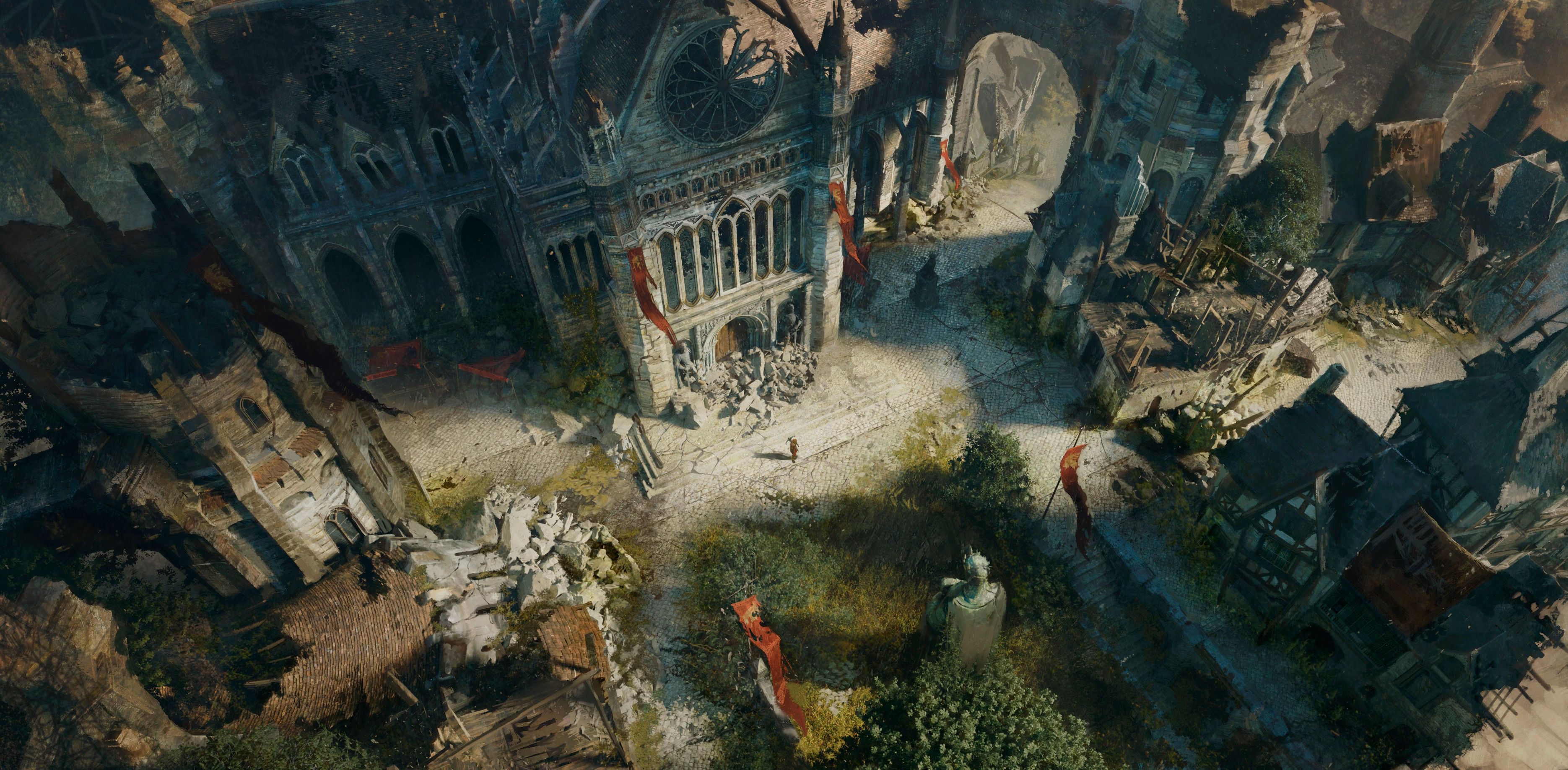
In Diablo 5, the western continent has fallen and is under the complete control of Diablo. As a result, it's not a world with bustling towns that can be restored and thrive once players kill enough demons nearby. Instead, a caravan will serve as the primary base of operations for the player and their crew, and both the overworld and dungeons will be procedurally generated with "tiles" whenever you venture out on a quest.
These tiles can have different looks, monsters, and treasure chest locations, but will also have some more significant changes depending on whether or not one of Diablo's Dread Commanders is in control of the area. "You might encounter a ruined church, and that ruined church can be represented in different ways depending on the state of the region when you're there," Shely provided as an example of its procedural generation in action.
While longtime Diablo fans will likely be happy about the return of procedurally generated overworlds, more recent games like Starfield have disappointed with how repetitive their procedurally generated areas felt, both in terms of visuals and the content available. I asked the developers how they plan to avoid some of the potential repetitiveness (more so than is already typical in a Diablo game), and they seemed confident that this would not be an issue.
"Well, we're going to build a lot of content," Shely stated. "But part of it is creating a balance between having an area of the world have some identity so that you have something that makes it like a place, but also have elements that can be different. So there's a balance between those two things that creates that sense [that] it's not just like we grabbed a pile of blocks and dumped them out on the floor and that's what you get. It's intentional."
Zitterman then chimed in to say that "this is a technology that we've been building on since Diablo 3" and that "when the time is right, we can deep dive a little bit more on exactly how some of the technology allows us to solve that problem." As such, it sounds like we'll learn a lot more about how Diablo 5's procedural generation works before the game launches in 2029.