Usual June Preview: Gaming's Secret Tastemakers Are Back with Spectral Crab Action
Overview & Key Takeaways
Finji has published some of the biggest indie games ever. Usual June is the company's next game, developed in-house, and looks awesome.
Usual June is anything but usual. Talking ghosts? Walking crabs? An interdimensional vortex beneath a 100-year-old cemetery? And all June wanted was a normal summer break.
If this sounds like the sort of indie gem that flies under the radar and then blows up your social feeds, you’re not off base. Usual June is developed by Finji, the Michigan-based company that’s sneakily become a modern kingmaker of indie gaming tastes. Finji has published some of the biggest breakout hits of the decade — including the Zeldalike Tunic, the adventure game Chicory: A Colorful Tale, and the narrative platformer Night in the Woods — but the company also develops its own games. Usual June is its next one, and Polygon is able to offer an exclusive look at the game for our annual Fall Preview.
“We were R&Ding and deciding what to make next back in 2020, 2021, and we did not make a fishing game based on Animal Crossing,” Finji cofounder and CEO Rebekah Saltsman said during a recent group interview attended by Polygon.
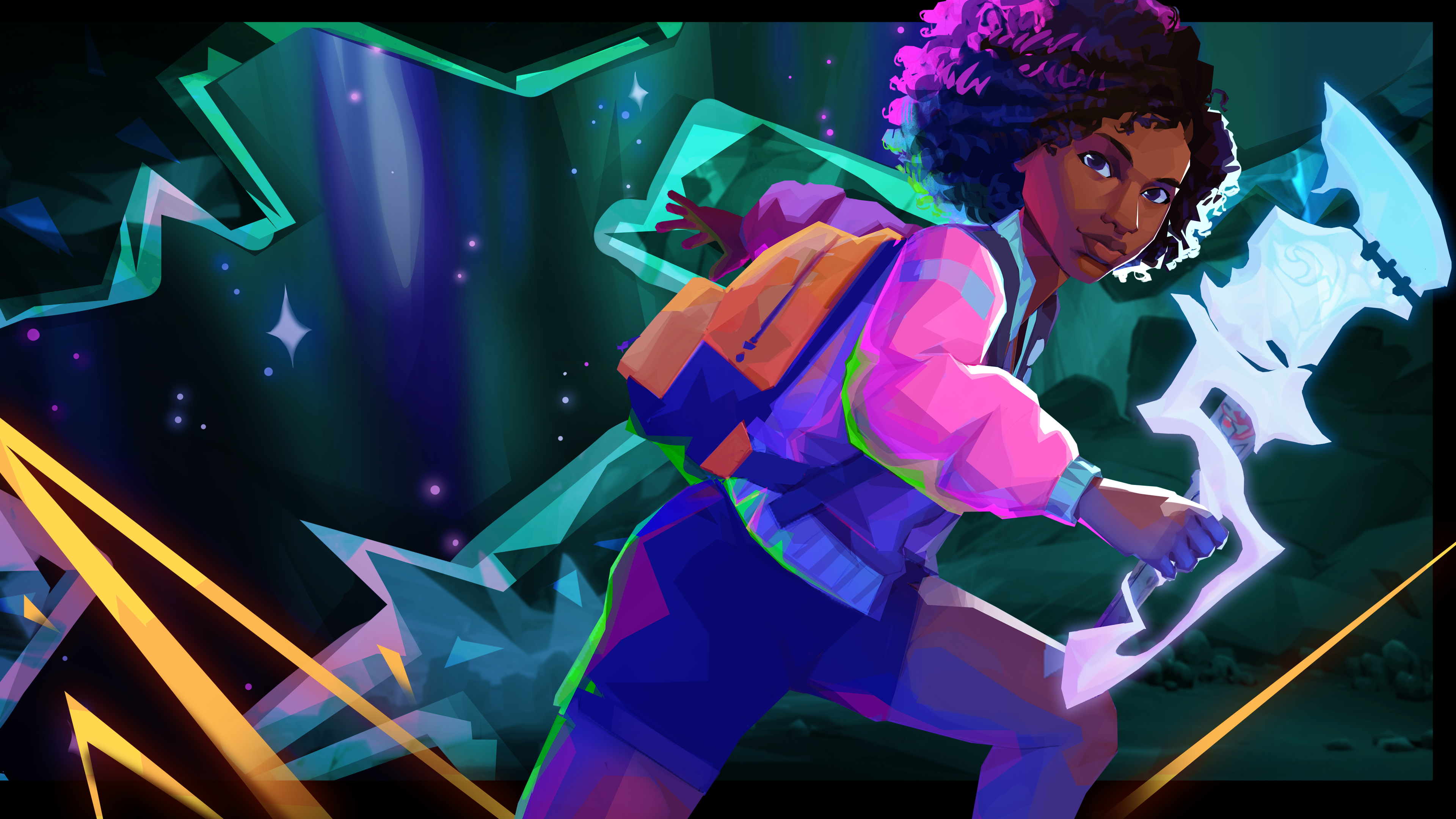
Instead, the Finji team took stock of what they wanted to make and how they wanted to spend the next few years. They ultimately landed on a genre-bending adventure game that mixes coming-of-age narrative exploration with Devil May Cry-style combat. Usual June follows the titular June, a young woman who lives in the fictional midwest college town of Fen Harbor, which looks like what would happen if you ran a Hallmark movie set through an indie game aesthetic filter. Finji is using the setting to inject some very real IRL commentary, too.
“When things come to an end in the Midwest, historically, it's because billionaires are done harvesting stuff there, and move on,” Adam Saltsman, Finji cofounder and Usual June’s game director, told Polygon in an email. (Adam and Rebekah are married, hence the shared last name.) “That's a pattern all over the world but it's writ very large and clear and recent all over the Midwest — this relationship with billionaire patrons, and wondering whether or not they'll allow your city to continue along its present track, or if they are going to put their fingers on the scale again, and what it might look like if they do that. When they do that.”
 Image: Finji
On June’s birthday (June 17, according to an in-game smartphone that serves as your menu), she and her friends end up exploring the local cemetery. A recent hands-on demo I played picked up shortly afterward, about 25 minutes into the game, according to Rebekah Saltsman. By this point, June and her friends had met a ghost, fought some spectral crabs, and found themselves trapped in an ancient mausoleum. While there, they discover an astral plane that could erase Fen Harbor from existence. Metaphors abound.
The first part of the demo involved walking around the crypt, trying to find a way out, but mostly chatting with June’s friends. It captures the light hijinks vibe of a late-semester evening with friends, strolling away from the dorms so your RA doesn’t yell at you for smoking weed by the entrance.
“When you're that age, especially if you're in college or at university or whatever, the vibe is kind of different and new from maybe how summer break would feel when you're growing up,” Adam Saltsman said. “Maybe you have to make rent, maybe you are taking summer classes, maybe you are, like, crashing at your friends place and doing nothing still, and then it's weird because the whole town empties out. … But there's still a looming feeling, right?”
 Image: Finji
 Image: Finji
 Image: Finji
 Image: Finji
 Image: Finji
Close
 Image: Finji
 Image: Finji
 Image: Finji
 Image: Finji
 Image: Finji
Usual June’s dialogue is snappy and flows the way a real conversation between twentysomethings would. (Cara Ellison, who’s worked in the narrative department on everything from God of War Ragnarök to The Seance of Blake Manor, consulted on narrative direction for Usual June.) Lead writer David Pinckney said these “quieter scenes” are more than just filler: They help round out the gameplay as well, so Usual June isn’t all just “combat and sleuthing.”
Notably, while the game features voice actors, it does not feature voiced dialogue. Instead, voices are rendered as — there’s really only one way to put this — twee art house gibberish. Finji worked with a team of Detroit-based actors to come up with various vocal tones and accents for each character, then applied a custom-built Vocaloid system to transform that in Usual June’s unique not-dialogue. (According to Rebekah Saltsman, it took audio designer Adam Hays “something like three years” to create this system.)
Usual June never surprises you with its combat: You can always tell when you’re about to get into a fight. Right before every encounter, you’ll come across a green screen blocking you from entering the combat arena, which allows you to see what enemies you’re about to face and map out a plan of attack. Pinckney described the game as having a “low skill floor and high skill ceiling,” a description that is, in my limited experience, right on the money. At Gamescom 2026, I saw Pinckney play through this exact combat sequence flawlessly. When I went hands-on with it myself, I… Look, I didn’t get my ass handed to me exactly, but let’s just say I lost a lot more health than Pinckney did.
 Image: Finji
 Image: Finji
 Image: Finji
 Image: Finji
 Image: Finji
Close
 Image: Finji
 Image: Finji
 Image: Finji
 Image: Finji
 Image: Finji
Combat is fast and fluid, and while there are parries in the game, there’s more of an emphasis on dodging. June’s dodge is a short-distance dash; time it right and you fill up her super meter, which allows you to perform more powerful attacks. There’s also a stylized frame rate effect, giving everything a comic-book look reminiscent of Spider-Man: Into the Spider-Verse. (For transparency, I played the demo on a Steam Deck, and had it crash before I turned down the settings to low. Usual June has not officially been verified for Steam Deck.) June’s health restores after fights, too, so you’re encouraged to go all out.
Typically, games with tight combat go all in on said combat; you never have to wait long before getting to the next fight. But Finji is happy to let Usual June go long stretches between battles, with lots of meaty dialogue sequences punctuating the action. The bonds June exhibits with her friends are just as engaging as the battles against giant spectral crabs. Over the course of my 30-minute demo, I found myself trying to fight my way through so I could experience more of her story. Then, during narrative sequences, I found myself pining to return to the fight.
This balance is an intentional choice: “We left room in the levels and between combat for how our four main characters might experience the discoveries they make, and what they mean,” Ellison said in an email interview.
But it’s that balance that has me most intrigued by Usual June: It’s more mechanically engaging than your typical indie-aesthetic narrative game, and is more reflective of real-world woes than your typical fast-paced action game. Finji has struck gold before, both with its own games and with those it’s curated through publishing. If the balance of Usual June pans out for the whole game, the company might just have the most unusual hit of the fall.
Usual June will be released Oct. 28 for Windows PC.