Slay the Spire Fans Need to Devour This New Game for Art Alone
Overview & Key Takeaways
Shroom and Gloom is ready for Early Access release in September 2026 and our preview shows off all the art.
There is no shortage of deckbuilders in the gaming ecosystem, and Slay the Spire casts a long shadow to this day (the sequel still sits among the most played games on Steam at any given moment). But the folks at Team Lazerbeam, self-described as “a video game band, here to make your life more rad” think there’s room in your heart from a ballistic mash-up of card-plucking roguelike and first-person action wrapped up in a punk cartoon aesthetic. Plus mushrooms.
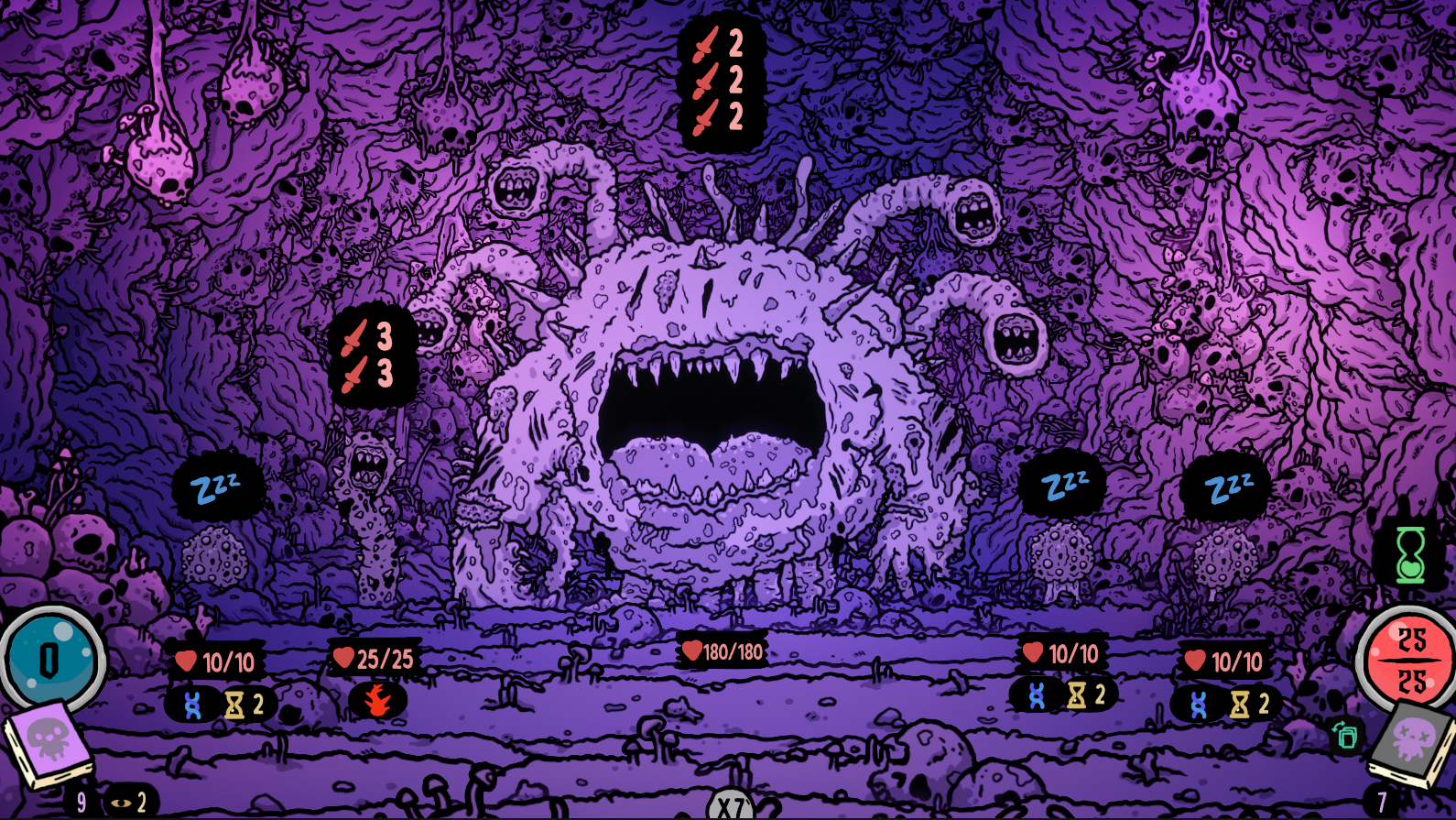
Shroom and Gloom, which goes into Early Access on Sept. 10, drops players into a fire-lit dungeon overrun with mycelium. Players use two decks: one that will help them navigate the winding subterranean tunnels and another to battle the monsters lurking within. As you chart a path to the Gloom, you unlock characters, cards, and more sick art.
For all the neat mechanic twists, what kept me charging into the unknown round after round was the eye-popping, hand-drawn art that fills every corner of Shroom and Gloom’s screen. Craft goes a long way when you’re trying to stand out in a packed genre, and as you’ll see below, Lazerbeam has gone all out to render its encounters in the most unique ways possible.
How did Team Lazerbeam bring it all together over the last few years? I asked Ben Rausch, one of Shroom and Gloom’s key artists and game designers, who shared all the splashy art that you’ll never actually see in the final game that makes the finished product possible.
Polygon: Were you always out to blend a bunch of different mechanics with Shroom & Gloom or did it start as a completely different thing that evolved into the finished direction?
Ben Rausch: We had a crystal clear vision of what we wanted the core idea of Shroom and Gloom to be, and that has mostly held true. We were inspired by games like Slay the Spire and borrowed from how they did certain things. But we intentionally made Shroom and Gloom in our own way; we wanted it to not be like Slay the Spire.
From the start, we wanted it to be a first-person deckbuilder, where it feels like you’re holding your cards in your hand and casting them into the world. And we knew we wanted to have two decks. Our one guiding rule was that everything that could be a card, should be a card. A lot of the smaller design decisions had to be refined over time, but the core idea was there from the get-go.
What did you learn from that first demo? What has morphed over two years in development?
We had a few phases of exploring the idea, even before we released the demo.
First was the original seven-day game jam (a first-person themed jam), where we explored the core idea of Shroom and Gloom. The second was a month-long art test to explore how we could push the visuals from what we set up on the jam. The third phase was the prototype from two years ago, where we had a full three months to combine what we learned in the jam and the art test, and distill the game to its core essence and see if it was something worth taking further.
The phased approach taught us a lot of lessons, and combined with heaps of player feedback, it was essential for keeping us going in some sort of direction. We were surprised by people's appetite for the game and how much more they wanted from it. We were going to make Shroom and Gloom more pared down, but realized that there was more space for depth. For example, we added characters, where before that wasn't in the plan. And we learned that people were curious about the lore and narrative. We have a very active local game dev community in Cape Town, and their feedback at meetups got us un-stuck more times than we can count!
Where did the art direction start? How did that evolve?
In part, the art direction is an extension of Team Lazebeam’s core aesthetic: hand drawn, cartoony, cute, funny, and a bit gross. We had a few projects where we experimented with 2D hand-drawn elements in a 3D world, but the seven-day jam pushed us to tackle a first-person deckbuilder in 3D.
We spent a full month on the art test to see how we could elevate it, and how far we could keep Team Lazerbeam’s punk art at a full-game scale. We also had to figure out how to practically incorporate our hand-drawn assets into such a massive world. It was as much a technical problem-solve as it was an art challenge. For example, we only use three colors when we draw — white, black, and grey. And we use lighting to add color, variation, and mood. We’re committed to everything being drawn by hand, and our stubby fingers are a testament to that!
The doodle-y monsters could literally look or be anything — how did home in on the final designs after early concepts? Is there a design approach that connects them all?
As part of the art test, we explored what the graycaps could look like. We figured out a social hierarchy, the different types of graycaps within the culture, their body textures and variations, and how they would move around in the world.
We experimented with a lot of different line widths and animation styles before settling on a set of guidelines for how they would appear, while still leaving a lot of room for each monster to have a unique identity and personality. We also considered the different parts of the world, and designed creatures that would fit into (and survive in!) the different biomes and levels.
Why was it important to sculpt the designs in 3D? Or go as far as to create clay models?
We built physical clay models for many of the characters to give them a sense of feeling grounded and believable. In some of our earlier sketches, we realized the monsters we drew wouldn’t be able to stand in the real world without toppling over. So it helped us figure out plausible proportions relative to gravity. This is why a lot of them turned out quite stout! The little sculptures were also great references for shading and depth when it came down to drawing the monsters in 2D.
How much time did you spend looking at actual mushrooms?
We are somewhat outdoorsy and very much inspired by nature, so we often come across mushrooms in the wild if the season is right. So we stop and take photos of even the tiniest, most mundane mushies to share with each other. We also grew our own mushrooms using growing kits. It’s fun to see how quickly they explode into fruit! We added mycology books to our library, and we look very closely at the food on our plates.
How do designs and animation cohere with the gameplay to enhance the whole package? What’s your theory on why the art makes it more fun to play?
We’ve noticed that the art draws you into the game, and the gameplay keeps you there. Like a venus flytrap.
I have a background (and foreground!) in animation and music, and many of the team members are visual artists and musicians in their own right, so it’s a natural focus for us. We create vibes first, and then build gameplay that supports the vibe.
Shroom and Gloom is currently available to wishlist.